role of capacitors in RF PCBs
Capacitors are crucial components in the design of Radio Frequency (RF) Printed Circuit Boards (PCBs), serving several key roles that enhance the performance and stability of RF systems. In RF applications, where signals operate at high frequencies and with strict requirements for precision and clarity, capacitors help ensure that circuits function efficiently while minimizing noise, distortion, and power fluctuations. The role of capacitors in RF PCBs extends beyond simple energy storage; they are instrumental in filtering, stabilizing, and coupling signals to optimize system performance.
One of the primary functions of capacitors in rf pcb is decoupling or filtering. High-frequency signals are often susceptible to power supply noise or fluctuations that can introduce unwanted distortions and reduce the quality of the transmitted signal. Capacitors placed across the power supply and ground planes provide a stable voltage to active components, such as amplifiers and oscillators, by filtering out high-frequency noise. They act as local energy reservoirs, supplying current during rapid changes in demand and smoothing out fluctuations. By minimizing noise from the power supply, capacitors ensure that the active components receive clean, stable power, which is critical for maintaining signal integrity and overall system reliability.
Another significant role of capacitors is in signal coupling. In RF circuits, capacitors are often used to couple signals between different stages of the circuit while maintaining signal integrity. Capacitive coupling allows for the transfer of an AC signal from one part of the circuit to another while blocking any DC components. This is particularly useful in systems where different parts of the circuit operate at different voltage levels or where isolation is necessary between stages. Capacitors provide a pathway for high-frequency signals to pass through while preventing unwanted DC bias or noise from affecting the downstream components.
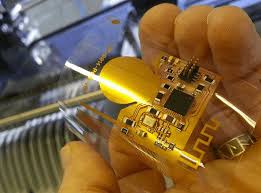
What is the role of capacitors in RF PCBs?
Capacitors are also employed in tuning and matching circuits within RF PCBs. In high-frequency applications, it is essential to maintain a proper impedance match between components and transmission lines to minimize signal reflection and loss. Capacitors are often used in conjunction with inductors and resistors to create impedance matching networks, ensuring that the signal travels through the system without degradation. These capacitors can be adjusted to fine-tune the resonance frequencies of oscillators or filters, making them vital in applications such as frequency modulation, radio transmission, and signal filtering.
In addition to their role in filtering and coupling, capacitors are integral to high-frequency signal processing. In RF applications, capacitors are used in combination with inductors to create filters that allow specific frequencies to pass while blocking others. For example, low-pass filters, high-pass filters, and band-pass filters rely on capacitors to control the frequency response of the circuit. By selecting capacitors with the right capacitance values, engineers can design circuits that allow only the desired frequency range to propagate while rejecting undesired signals. This filtering is particularly important in reducing interference from unwanted noise sources, thereby ensuring that only the desired signal reaches its destination.
Capacitors are also key components in stabilizing oscillators. In RF systems, oscillators generate periodic signals, often at high frequencies, that are fundamental to signal transmission. Capacitors help to stabilize these oscillators by controlling the frequency and amplitude of the oscillating signals. By controlling the timing characteristics of oscillators, capacitors ensure that signals are generated at precise frequencies and with minimal distortion. This is especially important in applications such as communication systems, where accurate signal generation is critical to proper operation.
In conclusion, capacitors play a multifaceted role in RF PCBs, contributing to the stability, performance, and efficiency of high-frequency systems. From filtering power supply noise and coupling signals between stages to tuning circuits and stabilizing oscillators, capacitors are indispensable components in ensuring the reliable operation of RF circuits. By carefully selecting the right type and value of capacitors, RF engineers can optimize signal integrity, minimize noise, and enhance overall system performance. As RF technology advances and operates at higher frequencies, the importance of capacitors in maintaining efficient and stable performance in RF PCBs continues to grow.